What Is Considered a Plumbing Emergency in Florida? (Clear Guide for Homeowners)

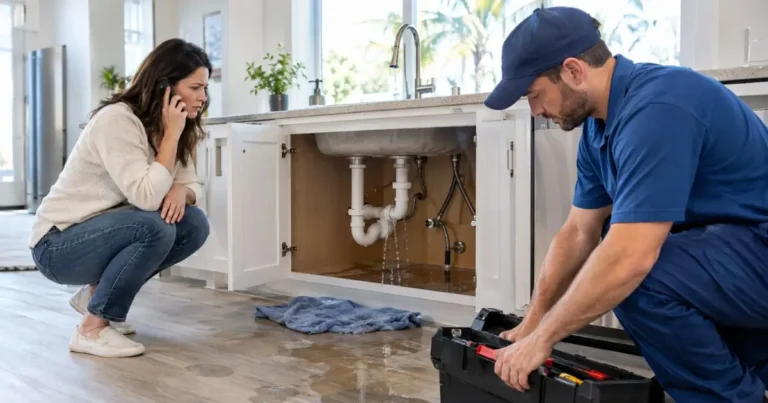
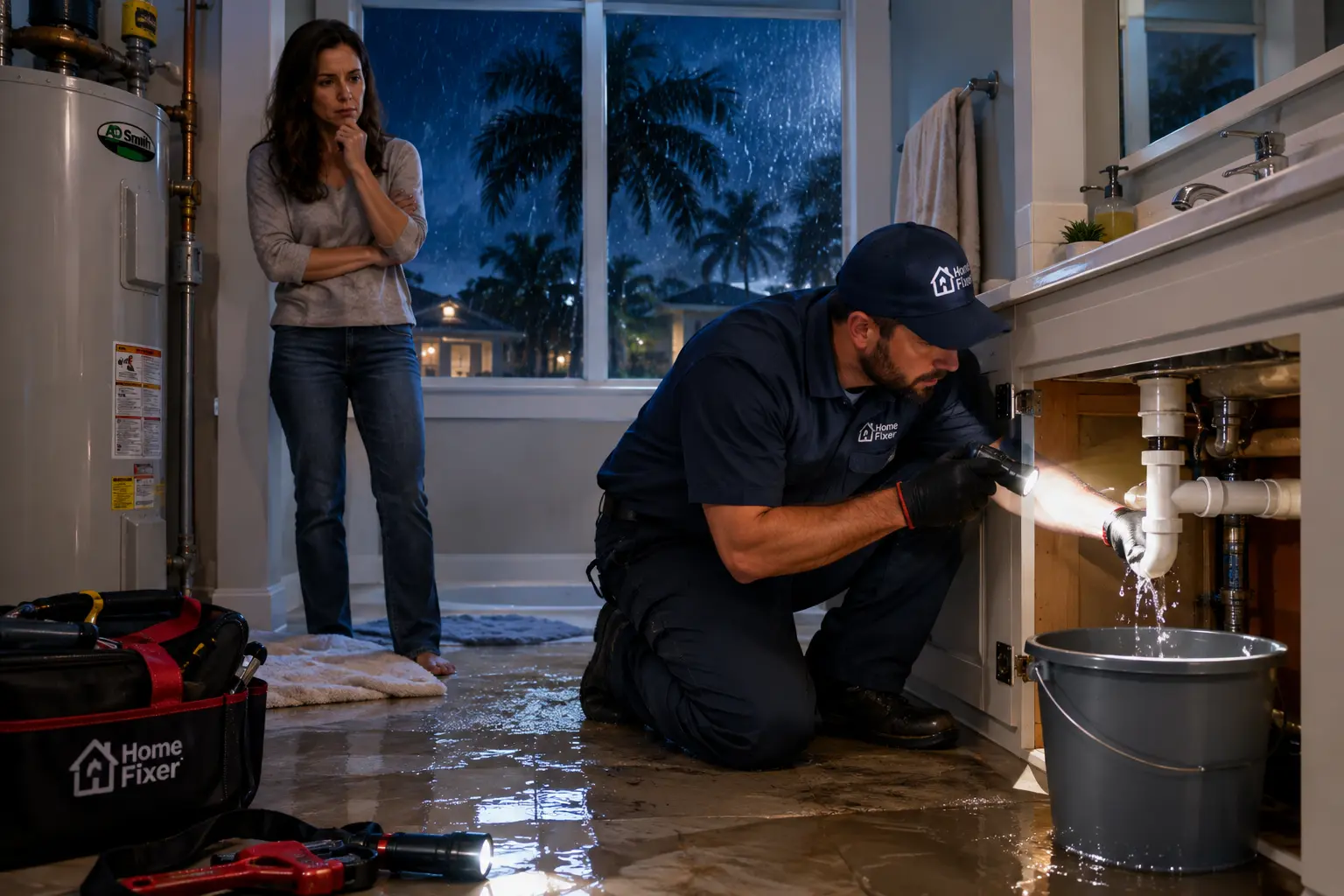
It’s 2 a.m. You hear water dripping behind a wall. Wastewater is backing up in the shower. Or you smell gas near the water heater. Is this a plumbing emergency in Florida?
Do you call a plumber right now or wait until morning?
In Florida that choice regularly turns a few-hundred-dollar fix into thousands in water damage, mold remediation, and structural repairs. Hard water, high humidity, slab foundations, aging pipes, and storm flooding make small problems escalate faster here than almost anywhere else in the country.
Last month our Home Fixer crews handled multiple overnight leaks across Central and South Florida where the homeowner waited until daylight. What started as a $450 repair turned into a $1,850 job once water soaked drywall, flooring, and insulation and mold began forming inside 24–48 hours.
We see this pattern every week. This guide is built from those real emergency calls, not theory.
What Counts as a Plumbing Emergency in Florida?
A plumbing emergency is any problem that is actively damaging your home, creating a health or safety risk, cutting off water, or getting more expensive every hour you wait.
At Home Fixer we use four questions on every call:
- Is water or sewage actively causing damage right now?
Burst pipe, major leak, overflowing toilet, or sewage backup = damage continues while you sleep.
2. Is there a health or safety risk?
Sewage, contaminated water, or gas smell near a water heater is never a “wait until morning” issue.
3. Has essential water service been completely cut off?
No usable water in the house is an emergency.
4. Will waiting make it worse?
Water moves behind walls, under floors, and into insulation long before you see the full damage.
In Florida the clock runs faster. Heat and humidity turn wet materials into mold within 24–48 hours. Slab leaks are especially dangerous—water can pool under the concrete foundation for days while the problem stays hidden.
Florida’s high humidity means mold can start growing on wet materials in just 24–48 hours — faster than in most other states.
The real question is simple: is the problem actively getting worse while you wait? If the answer is yes, it is already an emergency.
The 60-Second Plumbing Emergency Test
Not sure if you need an emergency plumber? Ask yourself these four questions:
- Is water or sewage still flowing or spreading?
- Is there a health or safety risk (sewage, gas smell, water near electrical)?
- Has an essential service been completely lost (no running water or major sewer blockage)?
- Could waiting until morning make the damage worse?
If the answer to any question is yes, treat it as a plumbing emergency and call a licensed Florida plumber.
Quick Reference: Common Symptoms & Urgency
| Symptom You’re Seeing | Most Likely Issue in Florida | Urgency Level |
|---|---|---|
| Water spraying or pouring from ceiling/wall | Burst supply pipe or major leak | Immediate |
| Sewage coming up in tub, shower, or floor drain | Main sewer line blockage or root intrusion | Immediate |
| Warm spots on floor + high water bill | Slab leak under the foundation | Immediate |
| Loud banging or rumbling from water heater | Heavy sediment buildup (hard water) | High |
| Multiple drains slow or backing up at once | Main sewer line problem | Immediate |
| Sudden total loss of water | Main water line break | Immediate |
| Rotten egg smell near water heater | Gas leak | Immediate (evacuate) |
| Water stains on ceiling that keep growing | Hidden pipe leak above | High |
| Toilet overflowing and won’t stop | Severe clog or main line issue | Immediate |
| Only one sink or tub draining slowly | Local clog | Can usually wait |
True Plumbing Emergencies in Florida Homes
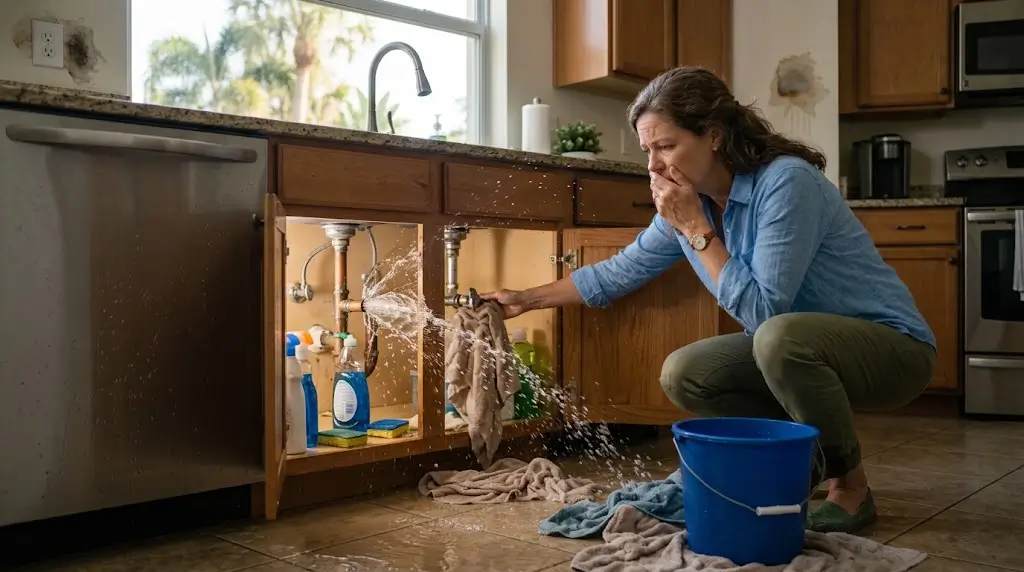
These problems should not wait until the next business day.
1. Burst or Actively Spraying Pipes
A burst supply line can dump gallons of water in minutes. Once it reaches drywall, flooring, cabinets, or insulation, the problem is no longer just plumbing. Shut off the main water supply if it is safe, then call a licensed plumber.
2. Sewage Backups
Sewage coming through a toilet, shower, bathtub, or floor drain is an emergency. It damages floors and walls and exposes the household to harmful contaminants. Recurring backups often point to a blocked or damaged sewer line, tree roots, or a problem with the main drain.
3. Major Uncontrolled Leaks
A leak inside a wall, under a slab, or from a water heater becomes urgent the moment you cannot stop the flow. Slab leaks are one of the most expensive plumbing emergencies in Florida. Detection alone usually costs $150–$400, while full repair commonly ranges from $1,500 to $4,000+, not including flooring or mold damage.
4. Complete Loss of Water
Sudden loss of water throughout the house usually means a problem with the main supply line or shutoff valve. In Florida heat this quickly stops being a minor inconvenience.
5. Suspected Gas Leak
If you smell the rotten-egg odor of natural gas, leave the house immediately. Do not touch light switches or anything that could spark. Once outside, contact the gas utility or emergency services. A licensed plumber can deal with the appliance or line only after the immediate danger is cleared.
6. Water Heater Tank Failure
A tank that is leaking from the bottom will keep releasing water until the supply is shut off. Water around the base, visible rust, or a rapidly growing puddle needs prompt attention.
An Overflowing Toilet or Fixture You Cannot Stop
A toilet that keeps overflowing even after the supply is shut off, or any fixture you cannot control, needs fast response—especially if it is the only working toilet in the house. When multiple drains back up at once, the main sewer line is usually involved.
In Florida, a typical emergency plumbing call in 2026 costs between $250 and $900. Waiting even 12–24 hours can easily push the total to $1,500–$5,000+ once water damage and mold remediation are added.
Emergency Plumber Cost in Florida
In Florida, the real cost of a plumbing emergency is rarely just the plumber’s bill it’s the water damage that follows In Florida, emergency plumbing costs in 2026 typically range from $250 to $900 for most common urgent calls. Complex jobs involving sewer lines, slab leaks, or significant water damage can go much higher.
Here’s a realistic cost breakdown for Florida homeowners:
| Problem | Typical Emergency Cost (Florida 2026) | What Affects the Price |
|---|---|---|
| Active leak / supply line | $250 – $900 | Access, pipe material, after-hours |
| Overflowing toilet | $200 – $600 | Local clog vs main sewer line |
| Drain blockage | $200 – $800 | Snaking vs hydro-jetting |
| Sewer backup | $500 – $2,500+ | Camera inspection, roots, contamination |
| Burst pipe | $400 – $2,500+ | Location + water damage extent |
| Water heater leak | $300 – $1,800 | Repair vs full tank replacement |
| Slab leak (detection + repair) | $350 – $4,000+ | Detection method + access under concrete |
What Home Fixer Technicians Actually See
A homeowner found an overnight supply-line leak and decided to wait until morning. When our technician arrived, the plumbing repair itself was straightforward. But several hours of continuous water flow had already soaked the surrounding drywall and flooring.
The plumbing repair came in at $450.
Once the damaged materials were assessed, the total restoration work reached $1,850.
The lesson is simple: the plumbing repair is often not the most expensive part of an emergency. The longer water stays uncontrolled, the more secondary damage it creates.
What Is Usually Not a Plumbing Emergency
Not every plumbing problem needs an emergency call. If the issue is contained, there is no safety risk, and the damage is not getting worse, it can usually wait until regular business hours.
- Slow drain in one sink or tub (water is still draining and no other fixtures are backing up)
- Dripping faucet or showerhead (not causing water damage)
- Running toilet that is not overflowing (you can shut off the supply valve)
- Low water pressure at one or two fixtures (rest of the house is normal)
- Small, contained leak you can safely catch with a bucket or towel
- No hot water (unless the water heater is actively leaking or creating a safety concern)
Florida-specific rule we use in the field:
If you can safely stop or contain the problem, nothing is being damaged, and there is no health or safety risk → schedule a regular appointment.
If the situation is actively getting worse → treat it as an emergency.
Even non-emergency moisture should not be ignored for long. Florida’s heat and humidity turn persistent dampness into a mold risk faster than most states.
Florida City-Specific Plumbing Patterns
Plumbing problems look different across the state.
Miami, Miami-Dade & Coral Gables
Older homes often still have aging pipes. Slab leaks are common and hard to catch early.
Watch for: unexplained jumps in water usage, warm or damp spots on floors, sound of running water when everything is off.
Fort Lauderdale, Weston, Pembroke Pines & Coral Springs
Heavy rain and tree roots put pressure on drains and sewer lines.
Watch for: several drains slowing at once, repeated toilet backups, gurgling sounds, or sewage odors.
Boca Raton, Delray Beach & Palm Beach Gardens
More complex systems and tankless water heaters. Mineral buildup is frequent.
Watch for: fluctuating hot water, reduced flow, unusual noises, error codes, or visible leaks around the unit.
Tampa, St. Petersburg & Clearwater
Storms and high water tables expose weak points quickly.
Watch for: slow drains after major weather, sewer odors, recurring backups.
Orlando & Central Florida
Mix of new construction and older properties with mineral buildup.
Watch for: reduced water flow, inconsistent hot water, popping or rumbling from a tank water heater.
Jacksonville & North Florida
Occasional hard freezes can burst exposed pipes.
Watch for: sudden loss of pressure or cracks that appear once temperatures rise. Protect outdoor plumbing before a cold snap.
What to Do Right Now in a Plumbing Emergency
- Shut off the water
Use the nearest fixture shut-off if safe. For bigger leaks go straight to the main shut-off (usually near the water meter, garage, utility room, or mechanical closet). Do not force a stuck valve. - Shut down the water heater if needed
Electric: switch off the dedicated breaker. Gas: follow manufacturer instructions and never create a spark if you smell gas. If you’re not comfortable, leave it alone and call. - Contain the water
Use buckets, towels, or a wet/dry vacuum. Move furniture and electronics. Never step into standing water near outlets or electrical panels. - If you smell gas, leave immediately
Do not touch light switches or use an open flame. Get everyone out and call the gas utility or emergency services from outside. - Document the damage
Once safe, take clear photos and videos for insurance. - Call a licensed emergency plumber
Stopping the visible leak is only the first step. The real cause still needs to be fixed.
One Tip Our Technicians Repeat Every Week
Locate your main water shut-off valve before you ever need it.
Take five minutes this weekend, find it, and make sure everyone in the house knows where it is and how to turn it off. In a real emergency those few minutes of preparation can save thousands in damage.
Extra Practical Tips from the Home Fixer Team
- Keep an emergency kit next to the main shut-off (adjustable wrench, bucket, absorbent towels, flashlight).
- Check plumbing after every major storm—run all fixtures and watch for slow drains, gurgling, sewage odors, or pressure changes.
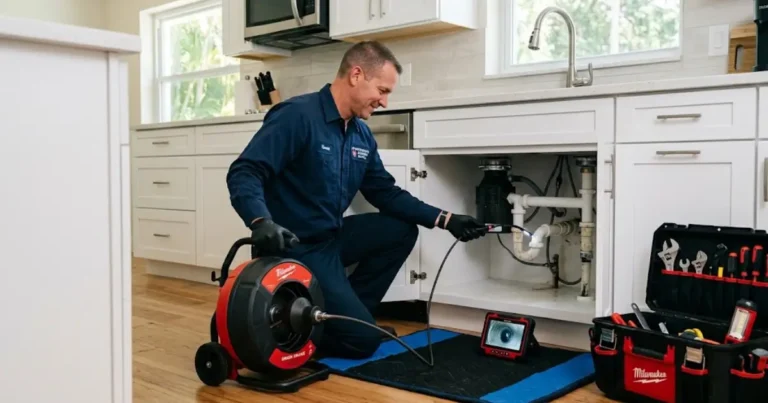
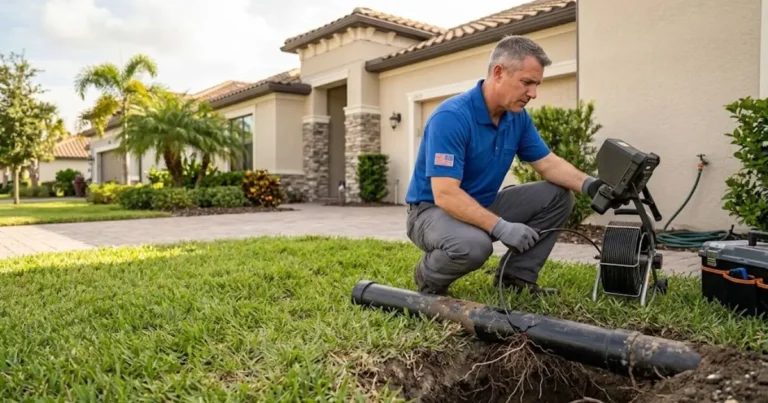
- Camera-inspect the main sewer line on older homes or when backups keep returning.
- Install water-leak detectors under sinks, near the water heater, and behind the washing machine.
- Skip chemical drain cleaners on serious clogs—they rarely fix the real problem and can create hazardous conditions for the next person who opens the pipe.
Why Florida Homes Face Greater Plumbing Challenges
- Hard water and mineral buildup reduce flow and increase maintenance.
- High humidity turns wet materials into mold faster than in most states.
- Slab foundations hide leaks under concrete for long periods.
- Aging systems (galvanized steel, cast iron, polybutylene) need closer inspection.
- Heavy rain, tropical storms, and hurricanes overload drains and raise backup risk.
Catch early warning signs instead of waiting for a small problem to become an expensive one.
Prevention Tips for Florida Homeowners
- Know every shut-off valve in the house.
- Inspect aging plumbing regularly.
- Address hard-water problems with a softener or treatment if testing shows high mineral content.
- Camera-inspect the sewer line when warning signs appear.
- Watch the water heater for corrosion, leaks, unusual noises, or inconsistent hot water—replace it on your schedule, not at 2 a.m.
Preventive maintenance is about catching problems early so you repair or replace components on your timeline, not during an emergency.
When in Doubt, Call Home Fixer
If you’re dealing with an active leak, sewage backup, or any urgent issue, our team provides fast emergency plumbing service across Central and South Florida.
Not sure if your plumbing problem can wait until morning? Call and tell us exactly what is happening. We will help you judge the urgency and what to do while you arrange service.
Our licensed Florida plumbers regularly handle active leaks, slab leaks, sewer backups, water heater failures, and other problems that get more expensive the longer they sit.
Our approach is simple: stop the immediate problem, find the real cause, and fix it properly—then show you how to lower the chance of the same issue returning.
If water is actively spreading, sewage is backing up, or you smell gas, do not wait. Take the safety steps first, then call a licensed professional.
Frequently Asked Questions
David Reynolds
I’ve spent over 25 years working as a plumber all across Florida fixing burst pipes, water heaters, sewer issues, and everything in between. After years of being out in the field every day, I stepped back from the hands-on work but still wanted homeowners to get solid, reliable help. That’s why I started Home Fixer. Now I work with a trusted team of licensed and experienced plumbers so people can get the same kind of service I used to provide myself.